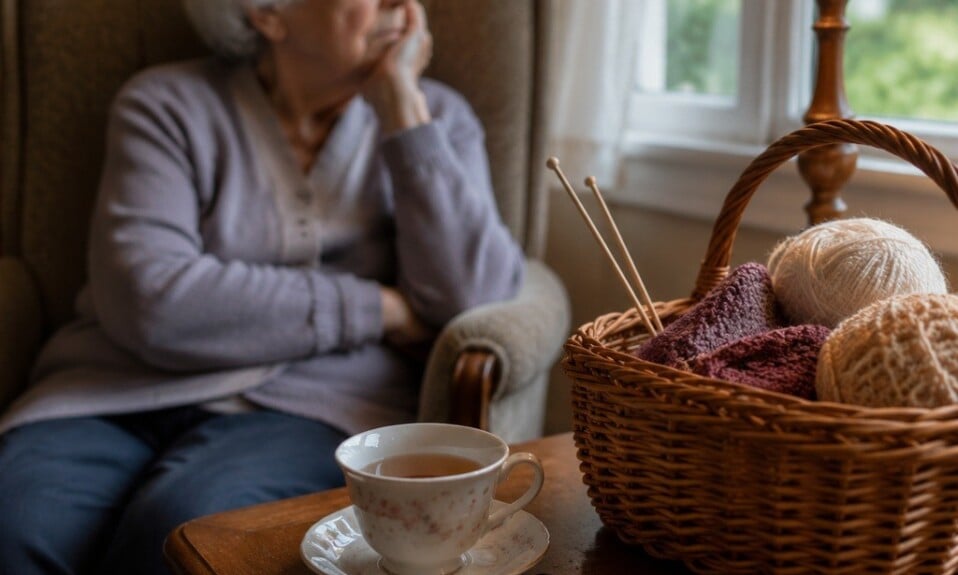

A compassionate letter for the widow who keeps meeting her husband’s absence in ordinary moments and needs permission to grieve gently.
Dear heart,
There are absences that do not stay where people think grief should stay. They move through the house. They sit in the chair. They wait beside the bed. They appear when something breaks, when the mail comes, when a show begins and you know exactly what he would have said.
Missing your husband is not only missing a person. It is missing a witness. It is missing the one who knew the small history behind your sighs, your looks, your routines, your old jokes, your stubborn ways, and the silence that did not need explaining.
People may have been tender at first. They brought food. They called. They remembered dates. Then slowly the world resumed its schedule, as if grief had been given enough time to be polite. But his absence kept arriving.
It may arrive in the second cup you no longer make. In the errand that feels too quiet. In the medical form that asks for an emergency contact. In the empty side of a decision you never used to make alone. Grief hides inside routines because love lived there first.
If you still talk to him, nothing is wrong with you. If you still turn toward his side of the bed in your sleep, nothing is wrong with you. The body remembers partnership before the mind can explain that the partnership has changed form.

Some days you may seem fine and then a smell, a song, a shirt, or a street corner takes the floor out from under you. That is not going backward. Memory is not obedient. Love does not arrange itself neatly because other people prefer a calendar.
There is no correct length of time for missing the person who shared your life. A husband's place in your heart is not a room you are required to empty.
At the same time, you may be tired of aching. You may want one ordinary hour that is not measured against what is gone. That wish is not betrayal. Even the deepest love can long for rest from the weight of missing.
Please let yourself have both truths. You can love him still and laugh at something silly. You can keep his memory close and move a lamp. You can honor your marriage and make the house serve the woman still living in it.
Widowhood can make everything feel like evidence. If you keep his things, are you stuck? If you move them, are you forgetting? But love is not measured by how untouched a room remains.
Sometimes the most faithful thing is to let the home hold both of you differently now. Keep what comforts. Release what only wounds. Open the drawer when you can. Close it when you cannot. Grief does not need one rule for every object.
The evenings may be the hardest. Daylight gives tasks. Night gives silence. Try not to judge what you need then. Turn on the lamp early. Let a familiar voice fill the room. Make tea. Put your feet under a blanket. Tell your body, in small ways, that it has not been abandoned.
If loneliness embarrasses you, be gentle. Missing conversation, touch, shared decisions, and another person's ordinary noises is not weakness. You are not less devoted because you need human warmth now.
There may be guilt over unfinished corners: words you regret, words you never said, a final day you replay too often. Long love is made of real days, not perfect scenes. You are allowed to forgive yourself for being human inside a human marriage.
And if the marriage was complicated, you are still allowed to grieve. You can miss the good, mourn the hope, feel relief, feel anger, and feel love. Grief rarely matches the simple story other people prefer.
Try to give one small piece of love somewhere to go. Write him a sentence. Say his name in the car. Cook something he liked or something only you like now. These are not replacements. They are ways of letting love breathe.
You do not have to stop missing him in order to keep living. The goal is not to erase the ache. The goal is to leave enough room for breath.
So tonight, if the house feels too quiet, may you remember that your grief is not failure. It is evidence that someone mattered in the daily places. And you matter in those places still.
There may be certain objects you avoid because they still have his voice around them. A jacket, a tool, a mug, a receipt, a note in his handwriting. Ordinary things can become emotionally loud after loss.
You do not have to decide about all of them now. Some belongings need time before they become only belongings again.
You may also feel the loneliness of making decisions alone. What to fix, where to go, whether to spend the money, who to call, what to do about the car, the house, the holiday. Partnership often lives inside decisions until the other half of the conversation is gone.
If you still ask him questions in your mind, let that be a form of love rather than a sign that you are stuck. The relationship changed shape; it did not become nothing.
There will be people who want you to be better because your grief makes them uncomfortable. Try not to hand them the authority to define your healing.
Healing may simply look like carrying his memory through a day without letting it crush you. That is not small. That is sacred ordinary work.
You are allowed to miss him. You are allowed to live. You are allowed to do both in the same breath.