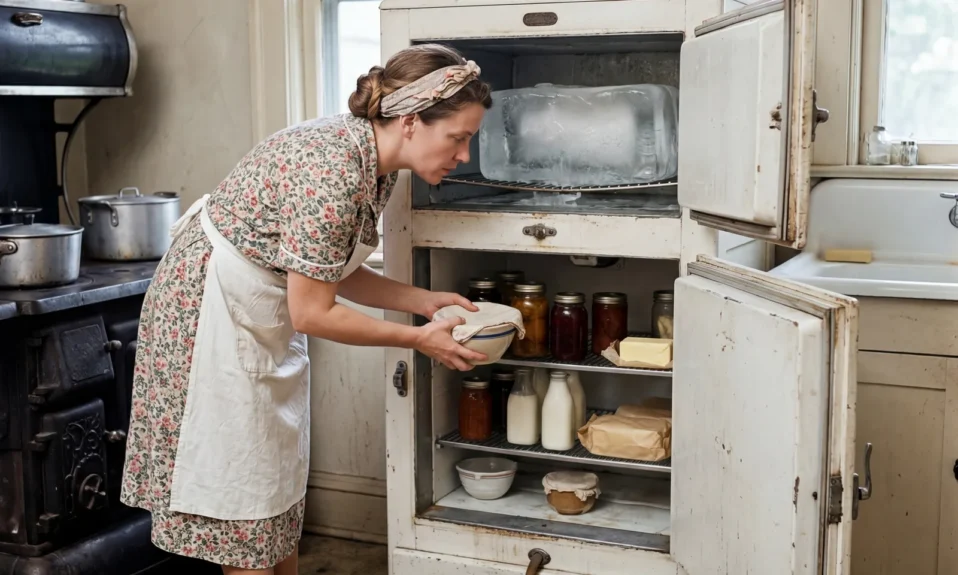
Imagine walking into a 1930s kitchen on a Tuesday morning. The stove is burning coal. There’s a smell of lye soap drying near the window. A woman is pressing a darning egg into a sock that’s been mended so many times the heel is mostly thread.
Nothing in that kitchen was wasted. Not the bread bag. Not the fat from Sunday’s chicken. Not even the string that came around the newspaper.
The Depression had a way of teaching people exactly what they needed and exactly what they didn’t. What they needed was very little. What they built from it was extraordinary.
We’re only two or three generations removed from all of it. But it might as well be a different planet.
These weren’t survival tricks or clever life hacks. They were just Tuesday. Normal Tuesday.
One of the items on this list is something every single family in America did without question. Rich or poor. City or farm. It’s item #1, and it’ll catch you off guard.
Keep reading. It only gets more specific from here.
5. Drying Fruit and Vegetables for Winter
Before the freezer, drying was how you kept summer alive through winter.
Apples were peeled, sliced thin, and hung on strings in the sun or spread on wooden racks in a warm oven. Green beans were threaded on long strings, a practice called “leather britches” across the Appalachian South. Tomatoes, peppers, corn, and herbs were dried and stored in cloth bags or tins. They reconstituted in soups and stews well enough to be worth the work.
Solar drying required specific weather conditions and took several days, which meant reading the sky accurately before starting. A rain that came in before the apples were done could ruin an afternoon’s work.
Knowing when to start drying and when to wait was its own form of knowledge. It doesn’t live anywhere now except in a few old books and the memory of people who learned it from someone who’s gone.
4. Keeping a Kitchen Garden Even in the City
If you had a patch of dirt, you grew food in it. This was not optional.
City families grew tomatoes, beans, lettuce, radishes, and whatever else the space and climate allowed. A window box could hold herbs. A strip of ground beside the building could hold more than you’d think. During the Depression, relief agencies and city governments actively encouraged urban gardening and sometimes provided seeds and tools.
The federal government ran community garden programs through the 1930s specifically to supplement relief food supplies in urban areas. Philadelphia, Detroit, and other industrial cities reported hundreds of thousands of family gardens during peak Depression years.
A tomato grown in a city backyard in 1934 was a political act as much as a practical one. Feeding yourself was a form of resistance to conditions that were trying to make you dependent on someone else.
3. Making Lye Soap from Wood Ash and Lard
Store-bought soap was something you used when you had extra money. Most of the time, you made it.
Lye was produced by leaching water through hardwood ash. The brown caustic liquid that came through the bottom was then combined with rendered lard or tallow and cooked slowly in a large kettle, usually outdoors because the fumes were strong. The mixture was stirred for hours until it saponified, then poured into molds to harden. The result was a rough, effective soap that cleaned clothes, bodies, and dishes.
Soap-making from scratch requires understanding concentration ratios, temperature, and timing. Too little lye and the soap stays greasy. Too much and it burns skin. Women who made soap regularly knew exactly what they were doing.
This wasn’t folk craft. It was chemistry running in the background of domestic life, practiced by people who never called it that.
2. Keeping a Darning Egg to Mend Socks
A worn sock wasn’t thrown away. It was sat down with.
The darning egg was a smooth wooden oval, about the size of an egg, that fit inside the sock to hold its shape while you wove new thread across the hole. The technique was methodical: run threads in one direction, then weave back through them in the other, building a patch of new fabric that held the original shape. When done well, the repair was nearly invisible. For another nearby rabbit hole, 25 Things Hotel Staff Notice About Every Guest the Second They Walk Through the looks at a related piece of everyday culture.
Darning was taught to children, both boys and girls, as a basic life skill. Needles, thread, and a darning egg were in every home. Socks wore through at the heel and toe because those were the points of friction, and darning extended their life by months or years.
A single pair of wool work socks in the 1930s might have been darned a dozen times before they were finally too far gone to mend. The eggs still turn up in estate sales and antique shops, smooth and familiar in the hand, completely baffling to anyone under sixty.
“It’s hard to believe we’ve forgotten it. But it doesn’t come close to what’s waiting at #1.”
1. Saying Grace Before Every Meal Without Exception
The One That Every 1930s Family Did Without Question
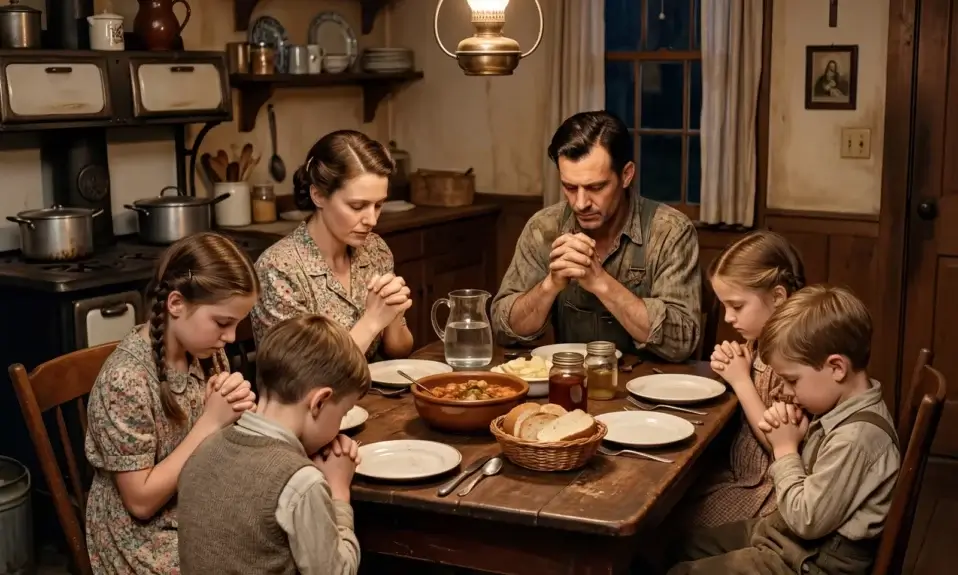
It wasn’t a religious statement. It was how you marked the fact that there was food on the table.
In a decade when millions of Americans stood in bread lines, when the Dust Bowl had stripped entire regions of their capacity to grow anything, when neighbors went without meals and families split apart looking for work, sitting down to a meal and acknowledging it out loud was not a ritual. It was reality. Readers who enjoy these kinds of details may also want The Slang That Defined Every Decade from the 1950s to Today for another quick detour.
Every family said grace. Not just churchgoing families. Not just rural families. Not just the devout. The practice crossed denominational, regional, and economic lines in a way that almost nothing else did. A Dust Bowl family in Oklahoma, a Black family in Birmingham, a factory worker’s household in Pittsburgh, a fishing family in Massachusetts. All of them bowed their heads. If you like this kind of overlooked detail, 35 Things Every 1930s Family Did That We’ve Completely Forgotten is another useful read to open next.
The words were different. Some were long and formal. Some were a sentence. Some were silent. But the pause was there.
A retired schoolteacher from Kentucky told me her grandmother described it simply: “We never once started eating without thanking God. Not once. Because we always knew people who didn’t get to eat that day.” If this part caught your attention, 25 Things Experienced International Travelers Always Pack That Most People Never gives you another specific angle to compare.
Gallup surveys from the 1930s show that over 75 percent of Americans identified as religious, and among those who did, daily or mealtime prayer was near-universal. But the practice went beyond the religious. It was a cultural baseline, a shared acknowledgment that food was not guaranteed. That same curiosity is what makes What Did ‘Groovy’ Actually Mean? The Real History worth checking after this section.
We live now in an era of such extraordinary abundance that the idea of food being uncertain feels abstract. We don’t pause before meals because there’s no reason to. The gratitude that grace expressed, the recognition that this meal was not inevitable, has almost entirely disappeared.
Grace was the daily reminder that having enough was not the default state of the world. The 1930s made that impossible to forget.
“Now you know why we saved this one for last.”
A Way of Life Worth Remembering
The 1930s family didn’t think of itself as resilient or resourceful or admirable. It just got through the week. What we’re looking at, from a distance of nearly a century, is what it looks like when people live completely inside their actual means, with complete attention to what they have.
If any of these caught you off guard, drop a comment below. And share this with someone who grew up hearing their grandparents talk about these things. For a different but related slice of the same world, 25 Things Hotel Staff Notice About You the Moment You Walk Through the Door in 2 is a good next stop.