

A soothing letter for the person who lies awake after 60 with old worries, memories, and the strange loneliness of the dark.
Dear friend,
Some nights do not feel like night. They feel like a long hallway you did not choose to walk down. The house is quiet, the room is dark, and suddenly every thought that behaved during the day comes back with a louder voice.
After 60, sleeplessness can carry more than tiredness. It can carry memory. Regret. Grief. Aches. Children you still worry about though they are grown. Money questions. Health questions. The strange awareness that time is moving whether you sleep or not.
That is why a wakeful night can feel so personal. The dark has a way of making ordinary worries sound like verdicts.
You may look at the clock and start bargaining. If I sleep now, I can still get five hours. Then four. Then three. Soon the math itself becomes another form of suffering.
Turn the clock if it bullies you. Truly. Some information does not help at 3 a.m. Your body does not need a scoreboard for its struggle.
Maybe grief visits at night because the day is too busy to let it speak. A spouse, a parent, a sibling, a friend, a younger version of yourself. The night may bring them back with almost painful clarity.
If that happens, try not to treat the memory as an intruder. Some memories knock because they still want tenderness. You do not have to solve them. You can simply let them sit for a moment and pass.
Other nights, it may be fear. A small symptom becomes a future. A bill becomes a disaster. A family tension becomes proof that nothing is secure. The tired mind is not always a fair narrator.
A helpful sentence can be, "This belongs to daylight." Not because the issue is fake, but because the dark is rarely the best courtroom. Some problems need a rested witness.
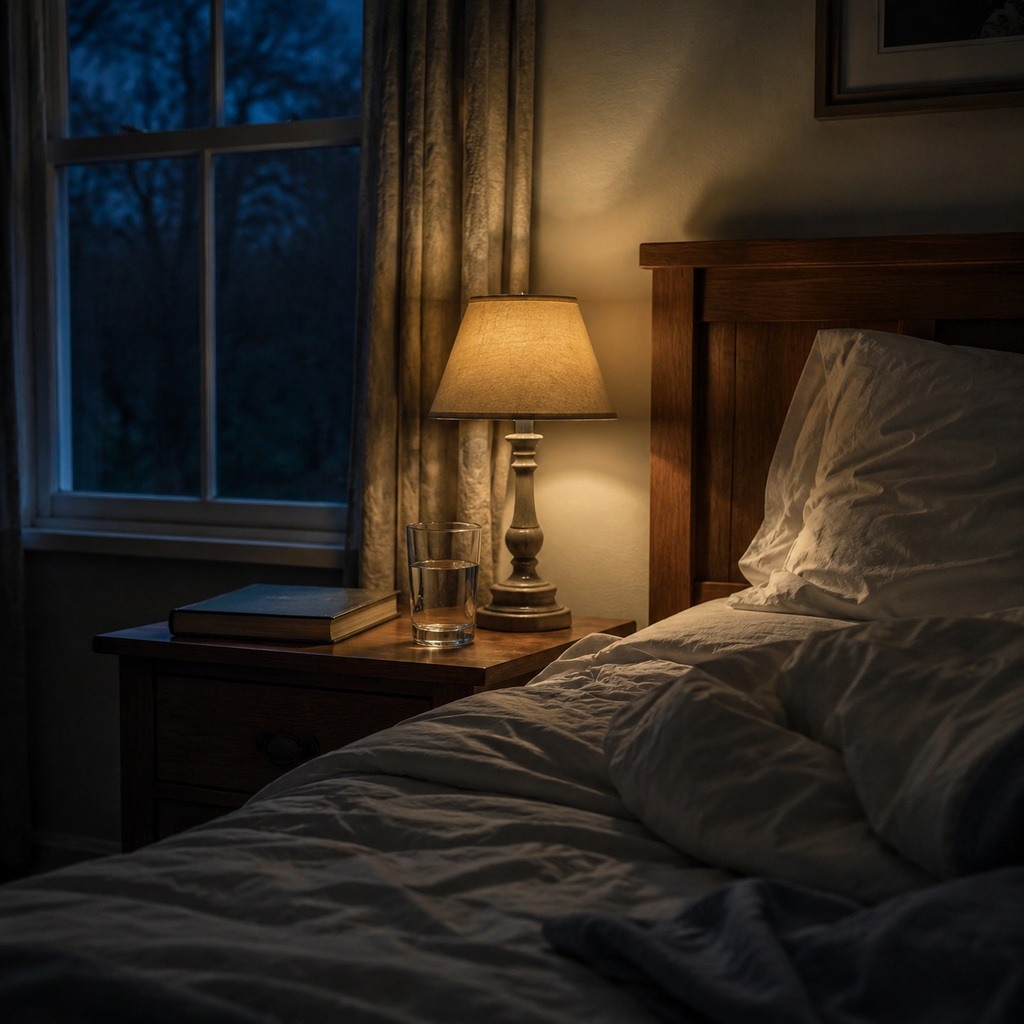
Make the night gentler before it turns sharp. Soft light. Water nearby. A familiar book. A chair that feels safe. A blanket that has weight. A notebook where circling thoughts can land instead of flying around the room.
If prayer is part of your life, pray without trying to perform calm. If it is not, breathe slowly and speak kindly to the body that is doing its best. Either way, you are allowed to seek comfort without earning it.
Please do not tell yourself you are ridiculous for feeling lonely while the world sleeps. Night loneliness is a real thing. A quiet room can make a person feel more alone than they are.
Somewhere, others are awake too. Someone is adjusting a pillow. Someone is missing a husband. Someone is listening to the heater. Someone is trying not to cry. You cannot see them, but you are not the only one keeping watch.
If sleeplessness is new, severe, or tied to breathing, pain, medication, depression, or fear, please ask for help. There is no virtue in enduring what could be treated. Rest is not a reward. It is a need.
But on the ordinary hard nights, lower the standard. You do not have to conquer the night. You only have to be kind enough to your body until morning finds you.
And morning usually does find you. Pale, imperfect, maybe tired, but real. The kettle works. The floor holds. The light returns without asking whether you handled the night gracefully.
The next morning after a sleepless night can make you feel older than you felt the day before. Everything is brighter, sharper, less forgiving. You may move through the house as if wrapped in thin paper.
Be gentle then. A tired body needs mercy before discipline. Drink water. Eat something steady. Step into light. Lower the demands if you can.
You may also notice that the night tells old stories in a harsher voice than daylight does. Regrets sound final. Fears sound certain. Loneliness sounds permanent. Then morning comes and some of those thoughts loosen their grip.
Remember that when the dark starts making declarations. Not every thought that visits at night deserves to be believed by morning.
If a memory keeps returning, consider giving it a daytime appointment. Write it down and promise to meet it after breakfast. The mind sometimes calms when it trusts it will not be ignored.
You are not weak for needing rituals. Rituals are how human beings cross difficult hours without demanding that willpower do all the work.
There may be a special ache when you wake from a dream of someone you miss. For a few seconds, the old world is near. Then the room returns, and the loss has to be learned again.
That kind of waking can color the whole morning. Dreams can reopen doors the day had managed to close.
If that happens, move slowly. Say the name if you need to. Drink water. Touch something solid. Let the present come back without forcing the memory to leave too quickly.
A tender morning after a hard night is not wasted. It may be exactly the mercy your heart needs.
You might also make a small promise to yourself before bed: if the night is hard, I will not use it as proof that tomorrow is ruined. That promise can soften the fear before it starts.
A bad night is real, but it does not get to write the whole next day before daylight arrives.
May your thoughts soften. May your room feel less like a test. And if sleep is slow to come, may you remember that wakefulness is not failure. You are still being carried toward morning.

