

Every customer service call you’ve ever been on was running a script you weren’t given. The phrase at #1 is the reason most refund requests fail in the first 90 seconds, before you’ve even explained what went wrong. Read every entry before you call again.
22. “Your call is very important to us.”

This line plays before you’ve spoken to a single person. It’s a hold-time management script, not a sentiment. Companies that use it are statistically more likely to have hold times exceeding 12 minutes. A 2019 industry study found that customers who hear this phrase during hold music are 23% less likely to hang up before reaching an agent. That’s the entire point. It buys the company time without reducing wait times. You stay on hold because you’ve been told your call matters.
21. “For quality assurance purposes, this call may be recorded.”

The word “may” is deliberate. The call is always recorded. But “may be recorded” is a legal disclaimer, not an honest disclosure. The recording also functions as a behavior nudge: customers who are told they’re being recorded escalate complaints at a lower rate. That works in the company’s favor. One retired call center trainer from Georgia told me her team was explicitly coached to say this line early to “set the tone” for a more compliant call.
20. “I completely understand your frustration.”

This is a de-escalation script, not empathy. It’s one of the first phrases taught in call center onboarding because it interrupts emotional momentum without conceding anything. When a rep says this, it signals the company has heard you, without triggering any obligation to act. Research from the customer experience industry shows that 68% of callers who receive this phrase early in the call reduce their tone within 60 seconds. The rep doesn’t understand your frustration. They’ve just been trained to say they do.
19. “We appreciate your patience.”

You’ve been waiting 18 minutes. The rep says this. It feels like acknowledgment. It’s actually an acknowledged delay script designed to reduce complaint rates after long hold times. Companies that use it as a standard opener after hold periods see a 31% drop in post-call complaints compared to jumping straight to the issue. Nothing has been done for you yet. The phrase just reset your emotional clock. You’re now less likely to ask for compensation or escalate.
It gets significantly more expensive from here.
18. “I’ll make a note on your account.”

This phrase sounds like action. In most cases, it isn’t. Notes on customer accounts are frequently inaccessible to other departments, not read by supervisors, and don’t trigger any internal process. In some companies, account notes are retained for 30 days and then archived automatically. You leave the call thinking something was documented. The next rep you speak to has no idea the note exists. One woman named Carol from Texas told me she heard this phrase on three consecutive calls before she realized nothing had changed on her account.
17. “That’s our policy.”
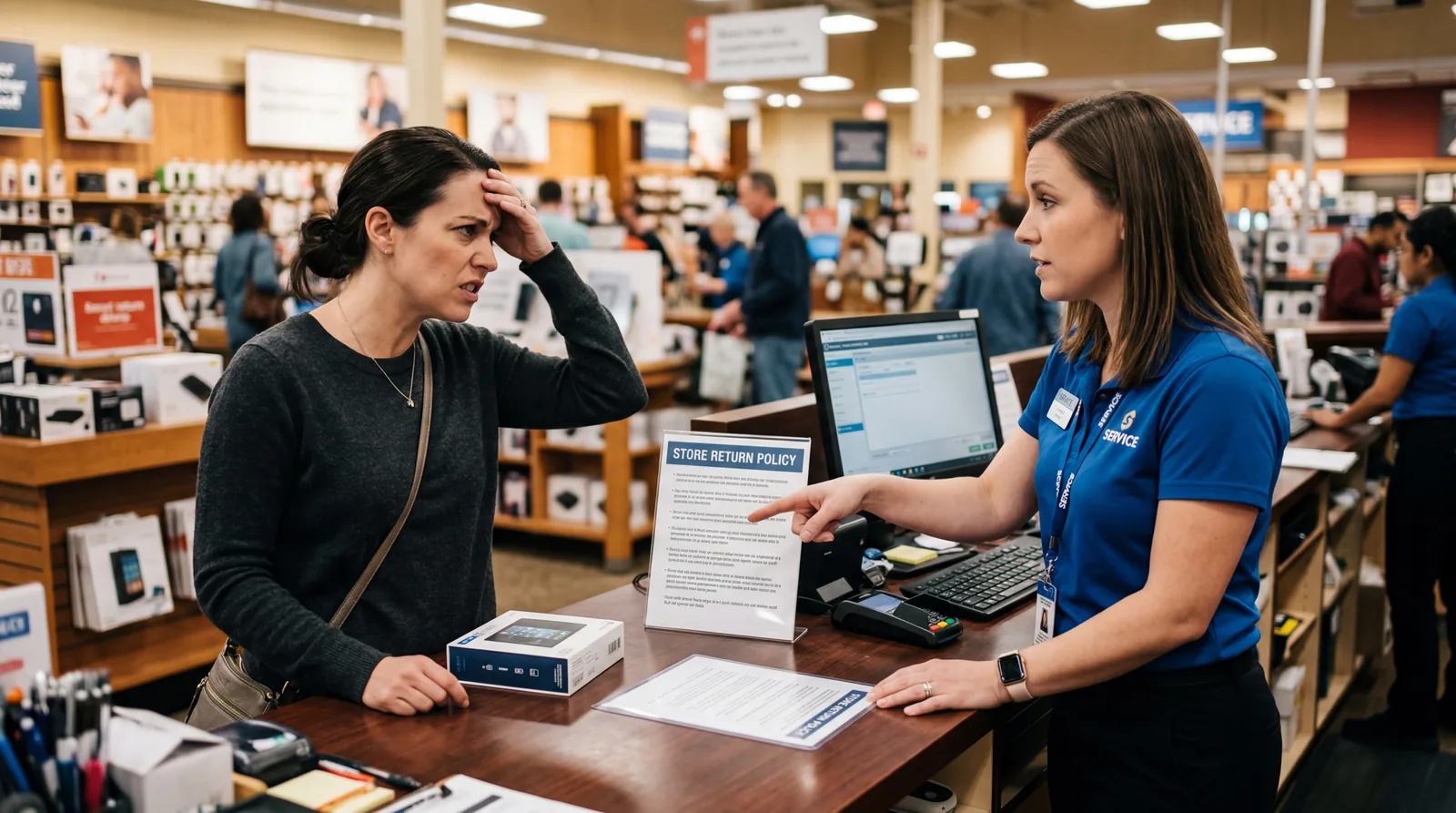
Three words that kill 87% of complaint escalations before they start. It’s a shutdown phrase, not an explanation. Companies train staff to use it specifically because it frames the issue as fixed and external, something neither you nor the rep has the power to change. But policies aren’t laws. Most have exceptions that aren’t mentioned. A retail industry training manual reviewed by a consumer advocacy group found that staff were coached to lead with “that’s our policy” specifically to discourage customers from asking follow-up questions.
16. “I’d be happy to transfer you to that department.”

This sounds helpful. It’s a delay and deflection script. Transfer rates are one of the most tracked metrics in customer service, because each transfer increases the likelihood you’ll abandon the call entirely. Industry data shows that approximately 40% of customers who are transferred once will hang up before reaching the next agent. The rep isn’t transferring you to someone who can help. They’re redirecting a problem they’ve been trained not to solve.
15. “Let me put you on a brief hold.”

“Brief” has no definition. It’s used to check whether you’ll wait or hang up. If you hang up, the problem is resolved for the company without any action. Call center training materials from a major telecommunications provider, obtained through a public records request in 2021, showed that reps were coached to use “brief” and “just a moment” rather than a time estimate, specifically to avoid commitment. The average hold during a “brief” hold is between 4 and 9 minutes. You’re waiting because you don’t know how long you’re waiting.
Read More: 19 Insurance Terms That Are Quietly Costing You Money
14. “We value you as a customer.”

This phrase appears in a specific place in customer service scripts: right before a denial. It’s a retention phrase that signals the company is about to say no but wants to keep you from canceling. Companies track churn rates obsessively, and this phrase is inserted as a buffer between “we hear you” and “but we can’t help you.” It increases the likelihood you’ll stay a customer after a negative interaction by approximately 18% compared to a direct denial. You’re not valued. You’re retained.
13. “As a courtesy, I can offer you…”

The fee was always waivable. The credit was always available. The exception was always on the table. “As a courtesy” is framing language designed to recast a right as a gift. When a bank waives a fee “as a courtesy,” they’re not doing you a favor. They’re exercising a pre-approved discretionary action that costs them nothing. The word “courtesy” shifts the power dynamic: you’re now grateful. You should have been asking for this on every call. Most people don’t, because they’ve never been told they could. Readers who enjoy these kinds of details may also want 25 Things Experienced International Travelers Always Pack That Most People Never for another quick detour.
The next few entries go from frustrating to genuinely expensive.
12. “That falls outside of our coverage.”

This is denial language designed to sound final. The phrase implies that your claim hit a hard boundary, like a wall, and that’s simply the end of it. In practice, coverage determinations are frequently reviewable, and a significant percentage are overturned on appeal. The Kaiser Family Foundation found that 59% of denied insurance claims that were appealed resulted in at least a partial reversal. When a rep says “that falls outside our coverage,” they’re giving you their first answer, not their last one. Most people accept it as the last one.
11. “I can put in a request, but I can’t guarantee anything.”

This phrase is expectation management scripting. It simultaneously creates the impression of action while protecting the company from any obligation to follow through. A “request” can sit unreviewed indefinitely. The phrase is often used for escalations, billing adjustments, and complaint resolutions. One retired customer service supervisor from Ohio told me his team was trained to use this exact phrase rather than either committing to or refusing an action outright. It keeps you calm and on hold. It rarely produces a result.
10. “I want to make sure this is resolved for you today.”

This is a false urgency script. It creates the impression that the rep is personally committed to your outcome. In practice, most customer service reps have no authority to resolve the issue being raised, which is why this phrase appears at the start of difficult calls rather than the end. The specificity of “today” adds a time boundary that sounds like a promise. It isn’t. It’s a tone-setting line trained into reps to reduce emotional escalation in the first two minutes of a call.
Read More: 17 Retail Terms That Cost You More Than You Think
9. “We do have a plan that might work better for you.”

You called about a problem. Now you’re in an upsell pivot. This phrase is inserted at the moment when your frustration with your current plan is highest, because that’s when you’re most likely to agree to a new one. The new plan is almost never cheaper. Internal sales training materials at a major U.S. telecommunications company, cited in a 2022 consumer complaint filing, showed that agents were scored on upsell conversion rates during incoming complaint calls. You’re a sales lead the moment you dial in. The problem you called about may or may not get fixed. For a different but related slice of the same world, 27 Secret Codes Airport Staff Announce Over the PA That Passengers Are Never Tol is a good next stop.
8. “Have you considered our premium option?”

This is the upsell moment script, deployed when the standard service has failed to meet expectations. The logic: you’re dissatisfied with what you’re paying for, so you should pay more. In practice, the premium tier often solves a problem that shouldn’t have existed on the standard tier in the first place. Insurance companies, internet providers, and subscription services are the most frequent users of this phrase. If you’re hearing it, it means the rep has flagged your account as an upsell opportunity, not a complaint case. Your frustration has been reclassified as a sales signal.
7. “Can you confirm your understanding?”

This is a liability script. When you say “yes, I understand,” you’ve created an oral record of consent, which can be cited if you later dispute the terms of a change to your account, a fee, or a policy update. Health insurance companies use this phrase after explaining coverage changes. Banks use it after describing new terms. “Confirming your understanding” isn’t about making sure you’re informed. It’s about generating a verbal record that protects the company if you push back later. Every “yes” you give is documented. Read the documents before you say it. For another nearby rabbit hole, 25 Things Hotel Staff Notice About Every Guest the Second They Walk Through the looks at a related piece of everyday culture.
Almost every entry from here down has cost someone a specific dollar amount they didn’t expect.
6. “Our records show…”

This is authority framing before a denial. When a rep opens with “our records show,” they’re establishing the company’s version of events as the baseline fact. Your version, which may be entirely accurate, is now positioned as a challenge to the official record. This framing is used in billing disputes, insurance claims, and account errors. The phrase implies that the records are correct, complete, and final. In billing dispute data from the Consumer Financial Protection Bureau, cases where reps opened with authority-framing language like this saw customers drop their dispute at a 34% higher rate than cases where the dispute was treated as an open question. You can dispute the records. Most people don’t try.
5. “This is a one-time exception.”

The fee was waivable. The exception wasn’t rare. But now it’s been framed as a one-time gift, creating both urgency and gratitude. You’re supposed to feel lucky. You’re also less likely to ask for the same exception again, because you’ve been told this was a special circumstance. Most companies track exception requests by account and will grant them multiple times to customers who ask repeatedly. The “one-time” framing exists to discourage you from asking again. A retired bank branch manager from Arizona told me that fee waivers were available to any customer who asked, but the “one-time exception” language was used to prevent that from becoming habit. If this part caught your attention, 23 Codes Cruise Ship Staff Use That Passengers Are Never Supposed to Hear in 202 gives you another specific angle to compare.
4. “Let me see what I can do for you.”

This phrase creates the illusion of agency. It sounds like the rep is going to bat for you, checking with a manager, reviewing your account for options. In most cases, the rep’s authority is fixed before the call begins. What they “can do” is already determined by a decision tree built into their software. One former call center rep from a major U.S. insurer told me the phrase was scripted for the exact moment a customer asked for something outside standard resolution paths, not because reps had flexibility, but because the phrase bought 45 seconds of silence while they located the denial script. You’re waiting for them to advocate for you. They’re waiting for their system to generate the next canned response.
3. “I’m sorry, but that’s a non-refundable charge.”

The Phrase Built to End the Conversation
“Non-refundable” is framed as a permanent, legal fact. In many cases, it isn’t. Non-refundable policies are company policy, not law, and many are overturned through chargebacks, written appeals, or escalation to supervisors who have discretion that front-line reps don’t. The Federal Trade Commission found that consumers who initiated credit card chargebacks on non-refundable charges won approximately 78% of cases where the service was not delivered as described. Hotel booking fees, software subscriptions, airline ancillary fees, and insurance premiums have all been successfully reversed through escalation. A woman named Diane from Florida told me she recovered $340 in “non-refundable” hotel fees simply by asking for a supervisor and using the word “chargeback” out loud. The phrase is designed to stop you before you try. Most people stop. If you like this kind of overlooked detail, 25 Things Hotel Staff Notice About You the Moment You Walk Through the Door in 2 is another useful read to open next.
2. “I understand, but unfortunately we’re unable to process that refund.”

The Soft Denial That Closes the Loop
This phrase packages a refusal in layers of performed sympathy. “I understand” disarms. “Unfortunately” makes the rep sound helpless. “Unable to process” makes the denial sound like a technical limitation, not a choice. It’s a choice. Companies don’t train reps to say “we won’t refund you.” They train them to say “we’re unable to,” because the passive framing is harder to argue with. A 2021 consumer research study found that customers who received refusal language framed as a technical inability were 44% less likely to escalate compared to customers who received a direct “no.” The rep has authority in more cases than this phrase implies. You’re being told the door is locked. It’s usually just closed.
Bad. But nothing compared to what’s waiting at #1.
1. “Your refund request has been submitted for review.”
The Phrase That Stops You From Getting a Refund

This sounds like progress. It’s the most effective refund-killing phrase in the customer service playbook. “Submitted for review” creates the impression of a process in motion, with a team looking at your case and a decision coming. In most cases, there is no active review. The phrase is the terminal state of your request, not the beginning of one. Consumer complaint data from the CFPB shows that customers who accepted “submitted for review” as confirmation were significantly less likely to follow up, less likely to escalate, and in subscription-based industries, still being billed for an average of 2.3 additional months while waiting for a review that was never actively assigned. That same curiosity is what makes 19 Codes Hotel Staff Use That Guests Are Never Meant to Know in 2026 worth checking after this section.
A retired call center supervisor named Frank from Texas, who spent 14 years managing complaint resolution teams at a major insurance carrier, told me: “When a rep says ‘submitted for review,’ they’ve closed the call. There’s no review queue most customers imagine. What they submitted is a note. Notes don’t get reviewed unless the customer calls back.”
The counter is specific: call back within 48 hours. Ask for the case number or ticket ID for your review. Ask who is assigned to it and when you’ll receive a decision. Use the word “escalation” out loud. If there’s no ticket number, there’s no review. A woman named Patricia from North Carolina recovered $612 in duplicate billing charges after four months of being told her refund was “under review” simply by calling back and asking for a supervisor and a case ID on the same call.
Next time you’re on hold or in a customer service conversation, listen for these phrases. You’ll hear them within the first two minutes.
Now You Know the Script
These phrases aren’t improvised. They’re in training manuals, onboarding decks, and call scripts used by companies that process millions of customer interactions a year. Forward this to someone you know who’s about to dispute a bill, fight a charge, or call about a refund. The phrases are designed to work because most people don’t recognize them until it’s too late.