

The last medical bill you received had codes on it you were never asked to approve, and most of them were chosen by the hospital, not your doctor. Hospitals and insurers have an entire vocabulary built around the idea that you’ll pay without reading. The code at #1 has added anywhere from $2,000 to $15,000 to a single hospital stay, and most people who were hit by it never knew it was there. Read every entry before you pay another bill.
25. Chargemaster Rate

The hospital’s internal price list is called the chargemaster. It’s the starting number before any insurance discount, and it’s completely made up. Hospitals set chargemaster rates at three to ten times their actual cost for a procedure. When you’re uninsured, you’re often billed at or near the full chargemaster rate. A single aspirin can be listed at $15 to $40. A routine blood draw at $300. These numbers exist to give insurers room to negotiate down, but uninsured patients pay the full list price unless they specifically ask for a cash discount.
24. EOB (Explanation of Benefits)

Your insurer sends you an Explanation of Benefits after every claim. Most people file it without reading it. That’s expensive. The EOB shows you exactly what was billed, what the insurer allowed, and what you owe. Errors in EOBs are common. A woman named Patricia from Missouri told me she found a $780 duplicate charge on an EOB for a routine physical, caught it only because a friend told her to check. The EOB is not a bill, but it’s the best early warning you have that something went wrong.
23. Facility Fee

You go to a doctor’s office. You get billed by the doctor. You also get a second bill from the hospital, even though you never set foot in one. That’s a facility fee. When a physician’s office is owned by or affiliated with a hospital system, they’re allowed to charge a separate “facility” line item. It has no standard definition. It can be anything from $200 to $1,500 on top of your regular copay, for the exact same visit. Many patients don’t realize until the second bill arrives weeks later.
22. Balance Billing

Balance billing happens when an out-of-network provider charges you the difference between their fee and what your insurer paid. You go to an in-network hospital, but the anesthesiologist or radiologist treating you is out of network. Your insurer pays their allowed amount. The provider bills you the rest. That gap is often $1,000 to $8,000, and in states without balance billing protections, it’s fully legal. The No Surprises Act capped some of this in 2022, but it has documented loopholes that providers are already using.
21. Observation Status

You’re admitted to the hospital. You spend two nights in a hospital bed. You get discharged. Then you get a bill for outpatient services. This is observation status. Hospitals classify patients as “under observation” rather than formally admitted. The difference is enormous: Medicare Part A covers inpatient stays, but observation stays are billed under Part B, which means higher out-of-pocket costs and no coverage for post-hospital skilled nursing care. A 2023 study found that observation stays cost Medicare patients an average of $3,200 more than equivalent inpatient admissions.
The next one is on almost every outpatient bill. Most people have no idea it’s there.
20. Modifier -25

Modifier -25 is attached to a billing code when a doctor performs a “significant, separately identifiable evaluation and management service” on the same day as a procedure. Translated: the doctor bills twice for the same visit. You came in for a minor skin removal. The doctor examined you first. That exam is billed separately under Modifier -25. The Government Accountability Office found that Modifier -25 was attached to claims where it wasn’t justified in up to 35% of cases reviewed. Each improper use adds $100 to $400 to your bill.
Read More: 27 Insurance Terms Your Provider Hopes You Never Google
19. Upcoding

Upcoding is when a provider bills for a more expensive procedure than what was actually performed. A level 2 office visit gets billed as a level 4. A 15-minute consultation gets billed as a 45-minute one. The codes are real CPT codes. The procedures they describe are not what happened. The Department of Justice recovers over $2 billion per year from upcoding fraud settlements, and those are just the cases that get caught. A retired insurance adjuster named Bill from Kentucky told me he caught his own cardiologist upcoding a $180 visit to $520 on three consecutive appointments.
18. Unbundling
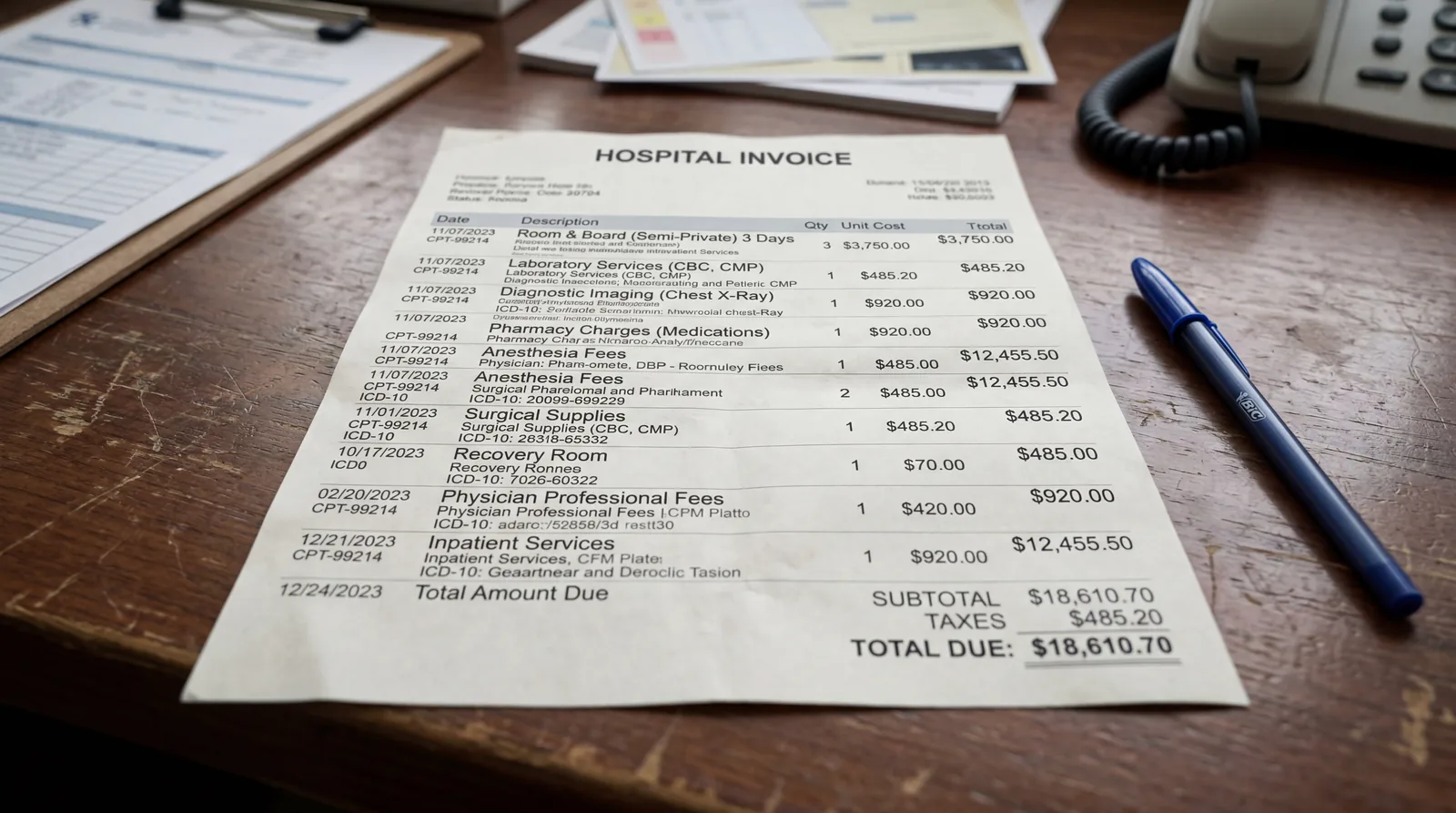
Some procedures have a single CPT code that covers everything, including pre-op, the procedure itself, and post-op care. Unbundling is when a provider splits that single code into multiple separate charges, billing each component individually. CPT code 27447 covers a total knee replacement as one unit. Unbundling it into separate codes for the incision, the implant placement, and the closure turns one $8,000 claim into a $14,000 one. The American Medical Association’s coding rules prohibit this, but it happens constantly in both inpatient and outpatient settings.
17. DRG Creep

Medicare pays hospitals for inpatient stays using Diagnosis Related Groups, called DRGs. Each DRG has a fixed payment based on diagnosis and complexity. DRG Creep is when hospital coders systematically assign patients to higher-complexity DRGs than their actual diagnosis justifies. A routine pneumonia case gets coded as pneumonia with complications. A standard hip replacement gets coded as one with comorbidities. Each upgrade adds $2,000 to $6,000 to the Medicare payment. A 2022 OIG report found that DRG upcoding costs Medicare an estimated $1 billion annually.
Read More: 23 Hospital Charges That Appeared on Bills Without Warning
16. Medical Necessity Denial

Your doctor orders a test or procedure. Your insurer denies it as “not medically necessary.” This sounds like a clinical decision. It isn’t. Medical necessity denials are made by insurance reviewers who are often not licensed in the relevant specialty, and in some documented cases, are not physicians at all. A 2023 Senate investigation found that one major insurer’s algorithm auto-denied claims in 1.7 seconds per claim, faster than any human review is possible. You can appeal. Most people don’t. The ones who do win more than 40% of the time.
15. Pass-Through Billing

When a hospital buys drugs or medical devices at a negotiated wholesale price and then bills your insurer at a dramatically higher retail rate, that’s pass-through billing. The hospital pays $40 for an IV bag and bills $400. They pay $800 for a surgical implant and bill $6,000. The markup is not disclosed on your bill. You see only the final charge. Pass-through billing is legal, and it’s one of the primary ways hospitals generate revenue beyond the procedure itself. A study in Health Affairs found markups averaging 518% over acquisition cost for implantable devices.
It gets more expensive from here. The next one shows up on your bill under a perfectly reasonable-looking name.
14. Cost Outlier

Medicare’s DRG system has a built-in exception: if a patient’s costs exceed a set threshold for their DRG, the hospital can claim an outlier payment for the excess. This was designed for genuinely catastrophic cases. Instead, some hospitals have used inflated chargemaster rates to artificially push routine cases into outlier status, triggering payments above what the DRG would normally allow. The Inspector General found that one hospital system received $97 million in outlier payments it wasn’t entitled to by systematically inflating charges on ordinary cases. You don’t see this one directly, but you pay for it in premiums.
13. Prior Authorization Loophole

Prior authorization is your insurer’s requirement that they approve a procedure before you have it. The loophole is this: approval can be revoked after the fact. Insurers sometimes grant prior auth, you have the procedure, and then they deny the claim during post-service review on grounds that weren’t raised during pre-authorization. You’re left with a bill that was previously approved. A woman named Denise from Arizona told me her insurer approved her back surgery in writing and then denied the claim for $28,000 six weeks after the procedure, citing a policy exclusion they never mentioned during the auth process.
12. Coordination of Benefits Error

If you have two insurance plans, one is supposed to pay first and the other covers what’s left. Coordination of benefits is the process that determines who pays what. Errors here are common and expensive. If your primary and secondary insurers each assume the other is paying, you can end up with $0 coverage on a claim both plans should cover. A man named Gerald from Ohio told me he spent nine months and $4,200 out of pocket on bills that should have been fully covered, all because his insurer had recorded his secondary plan incorrectly in their system.
Read More: 21 Insurance Claim Denials You Can Actually Win on Appeal
11. Modifier -59

Modifier -59 indicates that two procedures performed on the same day are distinct and not normally bundled together, justifying separate billing. It’s a legitimate code. It’s also one of the most abused modifiers in the billing system. The OIG identified it as a high-risk area in multiple annual work plans. When applied incorrectly, it allows providers to bill two separate procedure codes for what should be one combined charge. The average improper Modifier -59 claim adds $250 to $700 per incident. In high-volume practices, improper Modifier -59 use can generate hundreds of thousands in excess charges annually. For another nearby rabbit hole, 23 Codes Cruise Ship Staff Use That Passengers Are Never Supposed to Hear in 202 looks at a related piece of everyday culture.
The next four are where the real money goes. Each one has its own mechanism. None of them will be explained to you voluntarily.
10. Surprise Billing

You chose an in-network hospital. You chose an in-network surgeon. What you couldn’t choose was the out-of-network assistant surgeon, the out-of-network anesthesiology group, or the out-of-network lab that processed your samples. Surprise billing is the practice of charging in-network patients for out-of-network providers they had no ability to avoid or even know about ahead of time. Before the No Surprises Act, these charges averaged $1,400 per incident. After the Act, enforcement gaps mean surprise bills still reach patients in cases involving air ambulances, behavioral health, and certain specialties not covered by the law. For a different but related slice of the same world, 25 Things Hotel Staff Notice About You the Moment You Walk Through the Door in 2 is a good next stop.
9. Phantom Procedure Code

A phantom procedure code is exactly what it sounds like: a CPT code billed for a procedure that was never performed. This is fraud, not a gray area. But it’s documented fraud that happens with real frequency. The FBI’s annual healthcare fraud report consistently shows phantom procedures among the top three billing fraud categories. Common examples include billing for physical therapy sessions the patient never attended, lab tests ordered but never run, and procedures allegedly performed on patients who were discharged or deceased. A 2024 HHS audit found $1.3 billion in phantom procedure claims in a single audit of Medicare Advantage plans.
8. Diagnosis Creep

Diagnosis Creep is the gradual inflation of a patient’s listed diagnoses to justify higher payments. Each additional diagnosis on a Medicare Advantage claim is worth money to the insurer. Insurers are paid based on their enrolled members’ expected costs, which are based on diagnosis codes. When those codes are systematically added or upgraded, the insurer collects more from Medicare without providing more care. A landmark investigation by the Kaiser Family Foundation found that Medicare Advantage insurers collected an extra $12 billion in 2020 alone through diagnosis code inflation, and that the practice had been documented for over a decade without meaningful enforcement. That same curiosity is what makes 27 Secret Codes Airport Staff Announce Over the PA That Passengers Are Never Tol worth checking after this section.
7. Unbilled Negotiated Rate

Your insurance plan has a negotiated rate with in-network providers. That’s the contracted price your insurer agreed to pay. What some providers do is apply that discounted rate in the system but still balance-bill you for the difference as if you were uninsured. Or they process your claim at the out-of-network rate without telling you that in-network billing was available. A woman named Rhonda from Florida caught this on a $5,600 imaging bill that should have been processed at a $900 negotiated rate. She only found out because she called to ask why her claim was processed out of network for a facility listed on her insurer’s provider page. Readers who enjoy these kinds of details may also want 25 Surprising Items You Should Always Pack for International Travel in 2026 for another quick detour.
6. Retroactive Eligibility Termination

You go to the doctor while insured. The claim is processed. Months later, your insurer notifies you that your coverage was terminated retroactively due to a clerical error, a missed premium payment, or an enrollment issue, and demands repayment of every claim they paid during that period. Retroactive eligibility termination can generate recoupment demands of $10,000 to $60,000 for patients who were completely unaware their coverage had lapsed. Providers get clawback notices too and then re-bill you. This is most common with employer-sponsored plans where HR submitted incorrect enrollment data and the insurer flags it months after the fact.
5. Upcoded Evaluation and Management Code

Every office visit gets an Evaluation and Management (E&M) code. Level 1 is the simplest. Level 5 is the most complex. The level determines how much the insurer pays. Upcoded E&M codes are so common that the OIG dedicates an entire section of its annual Work Plan to auditing them. A level 5 E&M code reimburses at $250 to $370 per visit versus $80 to $130 for a level 2. Providers who systematically bill all visits at level 4 or 5 regardless of actual complexity can generate $150,000 to $400,000 in excess charges per physician per year. Your share, depending on your plan, can be an extra $40 to $120 per visit.
4. Out-of-Network Lab Billing

Your doctor is in-network. The lab they send your blood work to is not. You’re not told this. You don’t choose the lab. The results come back, the claim is processed, and you get a bill for lab work at out-of-network rates on tests ordered by an in-network provider. This is one of the most common billing complaints filed with state insurance commissioners, and it’s entirely legal in most states. The cost difference is significant: an in-network lipid panel runs $20 to $40 under your plan. The same panel billed out-of-network hits $180 to $400, with your responsibility potentially $100 to $280 depending on your deductible. The No Surprises Act doesn’t cover labs that receive separate referrals, and most do. If this part caught your attention, 25 Things Experienced International Travelers Always Pack That Most People Never gives you another specific angle to compare.
One more before #1. This one has been quietly operating since the 1980s, and it’s still the most legally protected overcharge in the system.
3. The Markup on Implantable Devices

When you have surgery that involves an implant, a pacemaker, a joint replacement, a spinal fusion hardware kit, the hospital buys that device at a negotiated vendor price and then marks it up before billing your insurer. The hospital paid $2,800 for your knee implant. They bill your insurer $17,500. The markup on implantable devices averages 400% to 900% over acquisition cost, according to a 2023 JAMA study. This is not disclosed to you at any point. It’s not itemized in a way that reveals the acquisition price. You see only the billed charge, and your cost-sharing, copay, or coinsurance is calculated against that inflated number, not the actual cost.
A man named Thomas from Texas, a retired hospital supply chain manager, told me he spent 20 years watching hospitals negotiate device prices down to almost nothing and then bill Medicare at four to eight times cost. “I watched a $180 catheter kit get billed at $1,400 on a Medicare claim,” he told me. “Every week. For years. Nobody stopped it.”
Your deductible. Your copay percentage. Your out-of-pocket maximum. All of them get calculated against the inflated number. Not the real one.
2. Observation Status Plus Skilled Nursing Facility Denial

This one combines two billing realities into a single trap that has cost some patients $30,000 to $100,000 in a single healthcare event. You’re admitted after a fall or stroke. You spend four nights in the hospital. You’re discharged to a skilled nursing facility for rehabilitation. Then you get the bills. The hospital classified your stay as observation status rather than an inpatient admission, which means Medicare Part A won’t cover the skilled nursing facility care. Medicare requires a three-day inpatient hospital stay before it covers SNF rehab. Under observation status, those days don’t count.
The SNF bills you directly at $200 to $500 per day. A four-week rehab stay at $350 per day is $9,800 out of pocket for care you thought was covered. If the SNF is higher-end, you’re looking at $600 to $900 per day, putting a six-week stay over $37,000. All from a coding decision made by a hospital administrator, not your doctor.
A woman named Carol from Michigan told me her husband’s stroke recovery ended with a $41,000 bill she didn’t know was coming. The hospital never told them he had been classified as an observation patient. “Nobody explained what observation status meant,” she said. “Not the doctor. Not the nurse. Nobody.” If you like this kind of overlooked detail, 19 Codes Hotel Staff Use That Guests Are Never Meant to Know in 2026 is another useful read to open next.
Bad. But nothing compared to what’s waiting at #1.
1. Medicare Advantage Risk Adjustment Fraud
The Most Expensive Code on This List

Every year, Medicare pays Medicare Advantage insurers a per-patient amount based on how sick their enrolled members are. Sicker patients cost more, so higher diagnosis codes mean higher payments from Medicare. This creates a direct incentive for insurers to find, add, or invent diagnoses on patient records that justify higher risk scores, whether or not those conditions are actively treated or even confirmed.
This is called risk adjustment fraud, and it is the largest documented source of overpayment in the U.S. healthcare system. It doesn’t show up directly on your Explanation of Benefits. You don’t get a line item for it. But it costs Medicare an estimated $75 billion per year in overpayments, according to a 2022 report by the Medicare Payment Advisory Commission. That cost flows back to taxpayers in the form of higher premiums and reduced Medicare solvency.
How it reaches you directly: insurers send chart review teams to audit your medical records and add diagnosis codes for conditions you may have mentioned once, years ago, that were never confirmed or treated. A retired teacher named Barbara from Georgia told me she received a letter saying her Medicare Advantage plan had added a chronic kidney disease diagnosis to her file. “I’ve never been told I have kidney disease by any doctor,” she told me. “Not once.” Her insurer received a higher annual payment for her enrollment because of that code.
The Department of Justice has filed False Claims Act suits against UnitedHealth, Humana, and Elevance Health (formerly Anthem) over risk adjustment fraud. A whistleblower lawsuit against UnitedHealth alleged that the company added $2.4 billion in unsupported diagnosis codes over a five-year period. The case is ongoing.
Your premiums reflect the cost of this. Your deductibles reflect it. The solvency of Medicare reflects it. It’s the most expensive code on this list because it isn’t one code. It’s a system designed to generate thousands of them.
Now pull out your last EOB. There’s a reasonable chance at least one of these codes is on it.
The Codes That Were Costing You Money Before You Knew Their Names
You can’t dispute a charge you can’t name. Forward this to anyone you know who’s facing a hospital bill, appealing an insurance denial, or about to enroll in Medicare Advantage. The information is free. The alternative isn’t.